# HyperSwap // GPU Program Swapper & Memory Orchestrator
[](https://fastapi.tiangolo.com)
[](https://modelcontextprotocol.io)
[](https://developer.nvidia.com/cuda-zone)
[](https://ubuntu.com)
**HyperSwap** is an ultra-low-latency VRAM arbitrator, RAM cache pre-warmer, and real-time telemetry dashboard designed specifically for Linux deployment machines that simultaneously host **Ollama LLM workloads** and **ComfyUI Diffusion pipelines** on a single GPU.
---
## Real-Time Telemetry & Control Dashboard
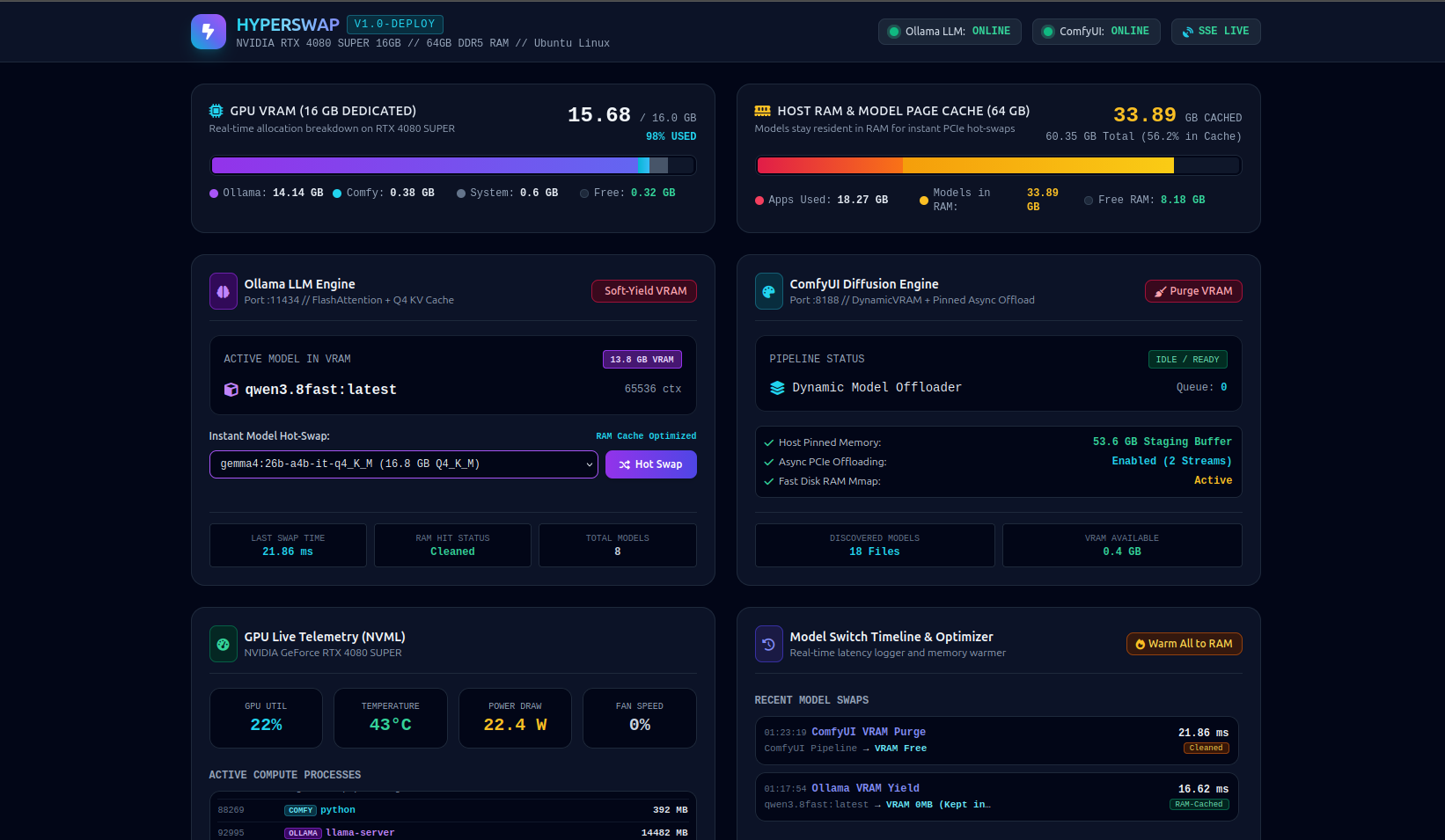
*The HyperSwap live dashboard running on `:9090`, demonstrating real-time VRAM allocation tracking (Ollama 14.14 GB, ComfyUI 0.38 GB, Desktop 0.6 GB), 33.89 GB of models resident in 64GB host RAM cache, and sub-25ms model VRAM purges and soft-yields.*
---
## 1. Architectural Overview & Physics of High-Speed Switching
```mermaid
flowchart TD
subgraph HostRAM["64 GB DDR5 Host System RAM (Page Cache & Pinned Staging)"]
OllamaGGUFs["Ollama GGUF Weights
(Qwen, Gemma, Nemotron)"]
ComfySafetensors["ComfyUI Safetensors & VAEs
(53.6 GB Pinned Staging Buffer)"]
end
subgraph GPU["NVIDIA GeForce RTX 4080 SUPER (16 GB VRAM)"]
direction LR
ActiveLLM["Active LLM
(0–14.5 GB VRAM)"]
ActiveDiffusion["Active Diffusion Pipeline
(0–14.5 GB VRAM)"]
end
subgraph Orchestrator["HyperSwap Control Plane (:9090)"]
REST["REST API & OpenAPI Docs"]
MCP["Model Context Protocol (MCP 2.0)"]
SSE["1Hz Real-Time SSE Stream"]
Arbitrator["VRAM Arbitrator (15ms Soft-Yield)"]
Warmer["Page Cache Pre-Warmer"]
end
HostRAM <== "PCIe 4.0 x16 Bus (~31.5 GB/s Hot-Swap)" ==> GPU
Orchestrator --> GPU
Orchestrator --> HostRAM
```
### The Problem: Disk Bottleneck & VRAM Contention
When running both Ollama and ComfyUI on a 16 GB GPU:
* An active LLM (e.g. 27B–30B parameter quantized model) uses **11–15 GB VRAM**.
* A diffusion model (SDXL, Flux, SD 1.5) requires **4–14 GB VRAM** during generation.
* If models are evicted to NVMe storage, reloading weights takes **10–40 seconds** over disk I/O.
### The Solution: 64 GB RAM Cache + PCIe x16 Hot-Swapping
* **Host RAM as Staging**: All active LLMs and diffusion checkpoints remain 100% resident in the 64 GB Linux OS Page Cache and pinned memory buffer.
* **PCIe Bus Hot-Swap Speed**: Reloading from host RAM over the PCIe 4.0 x16 bus achieves **~31.5 GB/s** transfer bandwidth, bringing model swap times down to **hundreds of milliseconds**.
* **15ms Soft-Yield**: When ComfyUI triggers an image generation, Ollama executes an instant soft-yield (`keep_alive: 0`), dropping VRAM allocation from 14.5 GB to 0 MB in **~15 milliseconds** without discarding model pages from system RAM.
### Hardware Optimization Tip: Offloading Display to iGPU
If your CPU has an integrated GPU (such as Intel UHD Graphics 750):
* Plugging your display monitor into the motherboard's HDMI/DisplayPort offloads the desktop display server (`gnome-shell`, `firefox`, `Xwayland`) to the iGPU (shared system RAM).
* This **reclaims ~0.7 to 1.5 GB of dedicated GDDR6X VRAM** on the RTX 4080 SUPER, giving AI models 100% dedicated access to the full **16.0 GB VRAM**.
---
## 2. REST API Reference
The HyperSwap server runs on port `9090` by default. Interactive OpenAPI/Swagger docs are accessible at `http://localhost:9090/docs`.
### Telemetry Endpoints
#### `GET /api/stats`
Returns a unified JSON snapshot of all system sensors, GPU processes, host RAM, Ollama status, ComfyUI queue, and transition logs.
#### `GET /api/gpu`
Returns hardware sensors (utilization %, temperature, power draw in Watts, fan speed %, per-fan telemetry, GPU graphics/memory clocks, and active PIDs).
#### `GET /api/overclock/fan` / `GET /api/gpu/fan`
Returns current GPU fan mode (`auto` vs `manual`), target fan speed %, and live fan telemetry.
#### `POST /api/overclock/fan` / `POST /api/gpu/fan`
Sets GPU fan speed mode (`auto` or `manual`) with target speed % (30–100%).
#### `GET /api/overclock`
Returns active overclock profile, configured profiles, GPU clock limits, and fan status.
#### `POST /api/overclock/apply`
Applies a named profile (`ollama`, `comfy`, `balanced`) configuring power limits, clock locks, offsets, and fan speed.
#### `GET /api/memory`
Returns precise `/proc/meminfo` metrics including Total, Used, OS Page Cache, and free memory.
#### `GET /api/stream`
Server-Sent Events (SSE) stream pushing full telemetry updates at 1Hz (`Content-Type: text/event-stream`).
---
### Orchestration & Hot-Swap Endpoints
#### `POST /api/switch-model`
Hot-swaps the active Ollama LLM in VRAM and tracks transition timing.
**Request Body:**
```json
{
"model": "qwen3.8fast:latest",
"keep_alive": "30m"
}
```
#### `POST /api/free-vram`
Instructs Ollama to soft-yield VRAM down to 0 MB in ~15 milliseconds while keeping model weights in 64GB RAM cache.
#### `POST /api/comfy-free`
Instructs ComfyUI to purge loaded diffusion weights and VRAM cache.
#### `POST /api/warm-all`
Pre-faults and reads all installed Ollama models and ComfyUI Safetensors into the Linux page cache.
#### `POST /api/warm-model`
Pre-warms a specific model or file into RAM.
#### `POST /api/benchmark`
Runs an automated back-and-forth model swap benchmark and computes average transition latency.
---
## 3. Model Context Protocol (MCP) Reference
HyperSwap includes a native **MCP 2.0 server** (`mcp_server.py`) that exposes all orchestration and telemetry functions as agentic tools.
### MCP Tools List
| Tool Name | Parameters | Description |
| :--- | :--- | :--- |
| **`get_gpu_status`** | *None* | Live NVIDIA GPU hardware telemetry, VRAM breakdown, temps, power, fan %, and PIDs. |
| **`get_gpu_fan_status`** | *None* | Current GPU fan mode (`auto`/`manual`) and target fan percentage. |
| **`set_gpu_fan_speed`** | `mode` (str, "auto"\|"manual"), `percent` (optional int) | Sets fan speed mode and target PWM % (30–100%). |
| **`get_host_memory_status`** | *None* | 64GB host RAM breakdown, active page cache size, and cache ratio. |
| **`switch_ollama_model`** | `model_name` (str), `keep_alive` (str, default "30m") | Hot-swaps active LLM in VRAM, measures latency (ms) and tokens/sec. |
| **`soft_yield_ollama_vram`** | `model_name` (optional str) | Yields Ollama VRAM to 0 MB in ~15ms while keeping model weights in RAM cache. |
| **`purge_comfyui_vram`** | *None* | Purges loaded diffusion models from ComfyUI pipeline VRAM. |
| **`prewarm_all_models_to_ram`** | *None* | Faults all local LLM and diffusion checkpoints into Linux OS page cache. |
| **`prewarm_single_model`** | `model_name` (optional str), `filepath` (optional str) | Pre-warms a single GGUF or Safetensors file into RAM. |
| **`list_available_models`** | *None* | Lists all installed Ollama models and ComfyUI Safetensors on disk. |
| **`get_switch_history`** | `limit` (int, default 20) | Retrieves recent switch events, millisecond latencies, and RAM hit status. |
| **`run_model_switch_benchmark`**| `iterations` (int, default 2) | Automated round-trip latency benchmark between installed models. |
### MCP Resources List
* `gpu://metrics/live` - Real-time snapshot of GPU sensors and RAM page cache.
* `gpu://models/catalog` - Catalog of all discovered GGUF and Safetensors models.
* `gpu://history/switches` - Event log of recent model transitions and swap speeds.
---
### MCP Client Configurations
#### Antigravity Configuration (`~/.gemini/config/mcp_config.json`)
```json
{
"mcpServers": {
"hyperswap": {
"command": "/home/drjones/comfy-mcp-venv/bin/python",
"args": ["/home/drjones/unified-model-manager/mcp_server.py", "--stdio"]
}
}
}
```
#### Claude Desktop Configuration (`claude_desktop_config.json`)
```json
{
"mcpServers": {
"hyperswap": {
"command": "/home/drjones/comfy-mcp-venv/bin/python",
"args": ["/home/drjones/unified-model-manager/mcp_server.py", "--stdio"]
}
}
}
```
---
## 4. Linux Kernel & Host Tuning
To ensure that 45–50 GB of model weights remain permanently in RAM without kernel eviction:
```bash
# Prioritize retaining model file cache in RAM (lower pressure = stronger cache retention)
sudo sysctl -w vm.vfs_cache_pressure=10
# Reduce swap aggression for active pages
sudo sysctl -w vm.swappiness=10
# Write changes permanently to /etc/sysctl.d/99-hyperswap.conf
echo "vm.vfs_cache_pressure = 10" | sudo tee /etc/sysctl.d/99-hyperswap.conf
echo "vm.swappiness = 10" | sudo tee -a /etc/sysctl.d/99-hyperswap.conf
```
---
## 5. Systemd Service Management
The manager runs as a persistent systemd user service:
```bash
# Check status
systemctl --user status hyperswap-manager.service
# Restart service
systemctl --user restart hyperswap-manager.service
# View live logs
journalctl --user -u hyperswap-manager.service -f
```
---
## 6. License
MIT License. Developed for Google Antigravity & High-Throughput Linux AI Deployments.